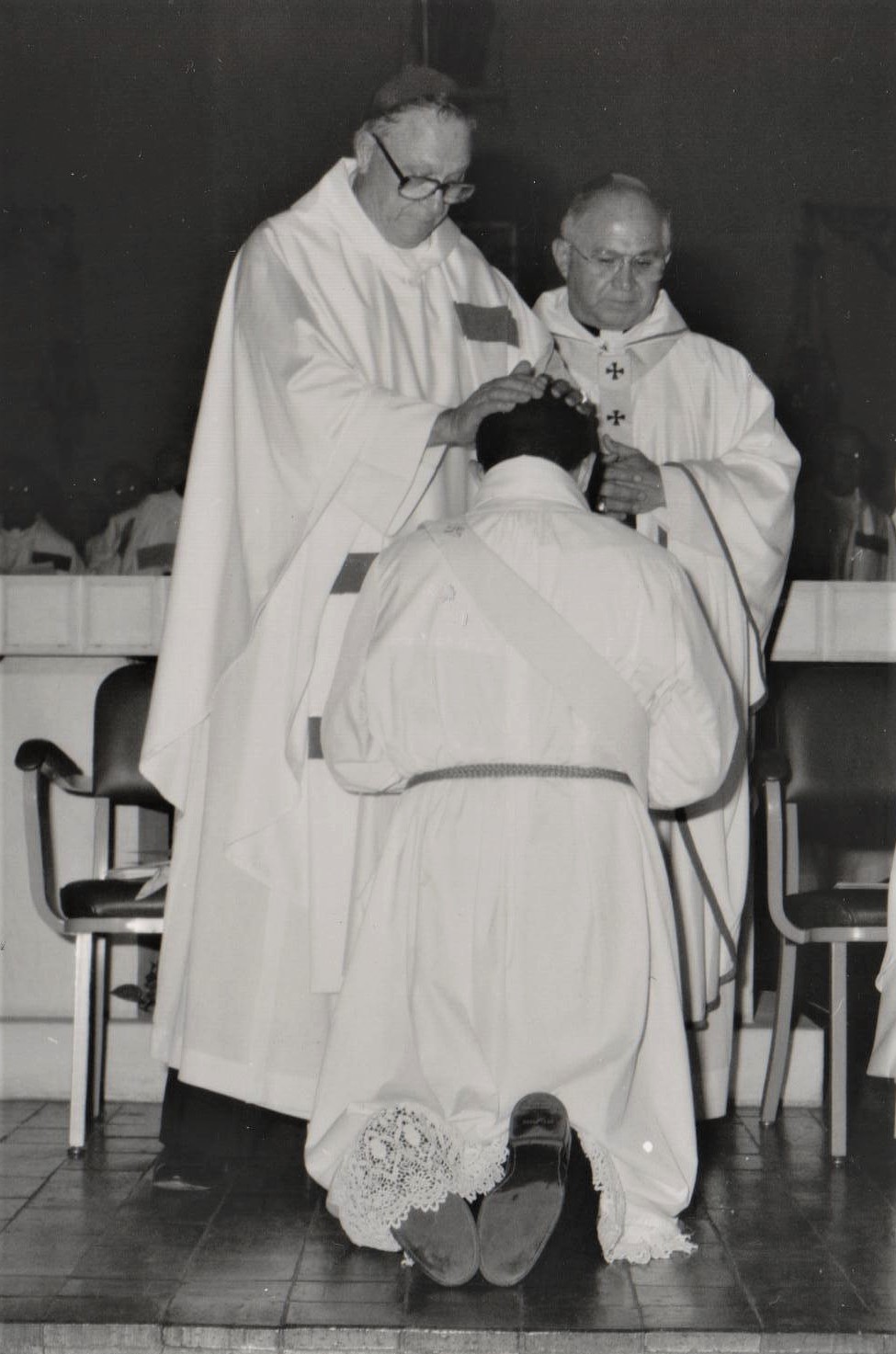
I was what might be called a rather conservative rebel.
In 1967 I was a seventeen-year-old college freshman, living away from home for the first time. I was raised as a Methodist, and had been very active in the local church: Sunday School, followed by the eleven o’clock service, and then back on Sunday evening for the weekly meeting of the Methodist Youth Fellowship. When I had packed my things and gone off to begin my college studies, it wouldn’t have been possible to have appeared any more solidly Methodist than I did. But it was the sixties, protest was in the air, and this was my time to be rebellious.
On my first Sunday morning away from home, I made a fairly outrageous decision, at least for me. I decided not to go to the Methodist Church. Rather, in the free spirit of protest, I headed off… to the Presbyterian Church.
Actually, my path of protest took me up Nassau Street in Princeton, New Jersey. The Presbyterian Church was several blocks away, and to get there I had about a thirty-minute walk. On the way, I would have to pass St. Paul’s Catholic Church. Now, up until this time, all I knew about the Catholic Church was what I had observed in the little corner of New England where I had grown up. And from what I could see, it seemed very foreign indeed - at least, when compared to what I was accustomed to. I had been inside a Catholic Church only once in my life. I was a very young boy at the time, and I didn’t remember much about it except for a very large, very pastel statue which I imagined was staring at me.
But now, here I was, a young man of seventeen, hundreds of miles away from home, feeling slightly wayward for shunning the Methodists, and now seeing a Catholic Church just ahead on my right. Crowds of people were pouring in – obviously, whatever it was the Catholics were accustomed to doing on Sunday mornings was about to begin – and I had to step a bit sideways to try and get by the stream of people. I had heard of getting “swept along by the crowd,” and that's what happened to me. As I was jostled along towards the front door, I had the fleeting thought that maybe this was my punishment for neglecting my Methodist duties.
The flow of people took me right into St. Paul’s Catholic Church. And what greeted me utterly astonished me, so much so that something stopped me from leaving. There were statues and votive candles. There were rosaries dangling from the hands of kneeling people. Then things began: there was chant, there was the whiff of incense, there were men and boys moving up the aisle in costumes unfamiliar to me. It would have been in Latin, I suppose, although I can’t say that I noticed. I was overwhelmed. And for most of the time, for some reason, I couldn’t take my eyes off a veiled object front and center, marked by a hanging lamp, which I learned much later was the tabernacle.
What (or more correctly, Who) was there, I did not know at the time, but my heart was touched in a way that it had never been touched before. I suppose, in a sense, I was following in the steps of my spiritual forebear, John Wesley, who described how his “heart was strangely warmed.” But this wasn't Aldersgate. It was St. Paul's on Nassau Street.
When it was over, I made my way outside, and went off to the later service at the Presbyterian Church. What the preacher said at that later service, I don’t remember. All I could think about was what I had seen earlier, and what I had experienced, and how it all seemed like a mystery. It reached the point subsequently that whenever I passed St. Paul’s, my feet carried me inside. And although I couldn’t admit it to myself, nor could I begin to explain it to myself, every time I went inside I felt like I was somehow “meeting Christ.” Those feelings would lead me out of the Methodist Church, carrying on my search for a while in the Episcopal Church, and then finally home, to the Catholic Church. I didn’t realize it at the time, but I was being evangelized by the Eucharist, and it had started long before I ever actually received Holy Communion.
St. John Paul II spoke frequently throughout his pontificate of “the task of the new evangelization.” In fact, he called that task “the greatest challenge facing the Church today.” Speaking at the Eucharistic Congress in Seville on June 5, 1994, he stated emphatically that this challenge can be most effectively accomplished by “evangelizing for the Eucharist, in the Eucharist, and from the Eucharist.” Our Holy Father gave the example of Christ Himself, referring to the event which took place on the evening of the Day of the Resurrection, recorded in the Gospel according to St. Luke (24:13-33), when Christ evangelized “in and from and for the Eucharist.”
That very day two of the disciples were going to a village named Emmaus, about seven miles from Jerusalem, and talking with each other about all these things that had happened. While they were talking and discussing together, Jesus himself drew near and went with them. But their eyes were kept from recognizing him. And he said to them, "What is this conversation which you are holding with each other as you walk?" And they stood still, looking sad. Then one of them, named Cleopas, answered him, "Are you the only visitor to Jerusalem who does not know the things that have happened there in these days?" And he said to them, "What things?" And they said to him, "Concerning Jesus of Nazareth, who was a prophet mighty in deed and word before God and all the people, and how our chief priests and rulers delivered him up to be condemned to death, and crucified him. But we had hoped that he was the one to redeem Israel. Yes, and besides all this, it is now the third day since this happened. Moreover, some women of our company amazed us. They were at the tomb early in the morning and did not find his body; and they came back saying that they had even seen a vision of angels, who said that he was alive. Some of those who were with us went to the tomb, and found it just as the women had said; but him they did not see." And he said to them, "O foolish men, and slow of heart to believe all that the prophets have spoken! Was it not necessary that the Christ should suffer these things and enter into his glory?" And beginning with Moses and all the prophets, he interpreted to them in all the scriptures the things concerning himself. So they drew near to the village to which they were going. He appeared to be going further, but they constrained him, saying, "Stay with us, for it is toward evening and the day is now far spent." So he went in to stay with them. When he was at table with them, he took the bread and blessed, and broke it, and gave it to them. And their eyes were opened and they recognized him; and he vanished out of their sight. They said to each other, "Did not our hearts burn within us while he talked to us on the road, while he opened to us the scriptures?" And they rose that same hour and returned to Jerusalem.
The Eucharist is at the very center of the Gospel revealed by Jesus Christ, and Pope Paul VI made this point in his decree
Presbyterorum Ordinis (ch.II, n.5):
The other sacraments, as well as with every ministry of the Church and every work of the apostolate, are tied together with the Eucharist and are directed toward it. The Most Blessed Eucharist contains the entire spiritual boon of the Church, that is, Christ himself, our Pasch and Living Bread, by the action of the Holy Spirit through his very flesh vital and vitalizing, giving life to men who are thus invited and encouraged to offer themselves, their labors and all created things, together with him. In this light, the Eucharist shows itself as the source and the apex of the whole work of preaching the Gospel. Those under instruction are introduced by stages to a sharing in the Eucharist, and the faithful, already marked with the seal of Baptism and Confirmation, are through the reception of the Eucharist fully joined to the Body of Christ.
It is in the Emmaus event that Christ lays out the model for evangelism. The two disciples are walking from Jerusalem to Emmaus, discussing the recent events in Jerusalem – Jesus' entrance into the city the week before, His subsequent trial before Pilate, His crucifixion and burial, and the rumors of His resurrection that had been running around all morning, ever since Mary Magdalene and Peter and John had returned from the empty tomb.
In the middle of their conversation, a stranger draws near and walks with them. It is Jesus, but “their eyes were kept from recognizing him," the Gospel tells us. Now certainly, if anyone would recognize Jesus, it would have been these two, who knew Him so well. But Jesus hides His identity for a time; He prevents the disciples from recognizing Him for a while, so that He can open their minds to the truth.
Their long faces betray their disappointment. Cleopas tells the whole sad story: how Jesus had been a prophet mighty in word and deed; how the chief priests and religious rulers had handed Him over to be crucified; how they had pinned their hopes on Him, thinking that He was the Messiah, the coming Redeemer of Israel. But things were looking pretty confusing. It was now the third day since His death. Some women had come with visions of angels and news of His resurrection. His tomb was empty, but Jesus was nowhere to be seen. What it all meant, they could not tell.
They had their facts about Jesus straight. Indeed He was a prophet mighty in work and word. Certainly He was rejected by His people and crucified. The women’s story was true: it was the third day and Jesus had risen. He was the One who had come to redeem Israel just as they had hoped. They had all the facts, but they didn’t have all these facts grounded in the reality of Christ’s death and resurrection. And this is a large part of evangelism: not only giving the facts, but also bringing an understanding of those facts.
A person can know the Scriptures. A person can know the catechism. A person might even be able to recite the Latin titles of all the papal encyclicals. But if those facts are not plugged into the power of the saving death and resurrection of Jesus Christ, none of it will make much sense or be of much use.
"O foolish men, and slow of heart to believe all that the prophets have spoken." Jesus chides them for their unbelief. They should have known. They had Moses and the prophets. It was plastered all over the pages of the Scriptures. The evidence was there for them. So, “beginning with Moses and all the prophets, he interpreted to them in all the scriptures the things concerning himself." Notice where Jesus directs their attention. Not into their own hearts. Not to their personal experiences or subjective feelings. He directs them to the revelation of Almighty God. Jesus opened up the Scriptures for them and beginning with Moses and going all the way through the prophets, He showed how His death and resurrection provide the rhythm of every passage.
Jesus gives the appearance of going on, past Emmaus, but the disciples insist that He join them for supper. It was nearing the end of the day, and evening was coming. Wouldn't He please stay and eat with them?
Though Jesus was their guest, He assumes the place of the host at the head of the table. He takes the bread, blesses and breaks it, and gives it to them. We cannot miss the connection with the Passover meal that Jesus had with His disciples, three days before, on the night in which He was betrayed. Here again is Jesus, taking bread and breaking it. And St. Luke tells us that "their eyes were opened and they recognized Him." In the breaking of the bread, in the Holy Sacrifice of the Mass, Jesus is recognized and known.
This is evangelism: Word and Sacrament. And that is what the Holy Mass is: Jesus serving us with Himself. Jesus making Himself known. Jesus being with us, objectively, really and truly, even when eyes are clouded. From the very beginning, the Church has understood this. Scripture teaches us that "they were devoted to the teaching of the apostles, to the fellowship, the Breaking of the Bread, and to the prayers." And because of that, the Church could be certain that the crucified and risen Lord was present among them, not only to save them, but to strengthen them to go into the world as He had commanded them, making disciples of all nations. And Scripture further teaches us that “the Lord added to their number day by day those who were being saved.” They needed no programs, no gimmicks, no publicity stunts, no mass marketing. They had the Word and the Sacraments. That's all they needed. And the Lord added daily to their number.
We are called to one thing: to be faithful – faithful to God’s revelation; faithful in our sacramental life; faithful in giving glory to God; faithful to the teaching of the Church; faithful to the traditions which the Church has exhorted us to maintain. Those are the ingredients of success. We are to be a people whose “hearts burn within them” with a love for the Lord Jesus Christ. And we are to be a people whose eyes have been opened to “recognize the Lord Jesus Christ in the Breaking of the Bread.”
Success in evangelism is so simple: just as Jesus is at the center of our churches in our tabernacles, so we are to keep Jesus at the center of our lives in the tabernacles of our hearts. This is the best and strongest tool we have for the work of evangelism. And this is why we must proclaim in the strongest possible way that Christ Sacrificed and Christ Present is the center and foundation of our being.
Because we never know when a young seventeen-year-old rebel might wander in.


.jpg)