Saturday, August 5, 2023

The Transfiguration of Our Lord


It was an astonishing sight for Peter, James, and John, when they saw the Lord Jesus Christ radiating His divine glory, talking with Moses and Elijah. He manifested His glory, the glory that was His as the only begotten Son of the Father - God of God, Light of Light, very God of very God. 

His face shone like the sun. His clothing became blinding and brilliant, whiter than any bleach on earth could bleach them. His divine nature shone through His humanity, making it clear that our Lord Jesus Christ is at once true God and true man. But He isn't like two things that are mixed together to form a third thing. He isn’t a hybrid of God and man. He is neither a “super man” nor is He a lesser god. He is the God-man, the unique Person in whom the fullness of the Deity dwells in human flesh and blood. That's what the disciples glimpsed on the mountain that day. They saw Jesus in His glory as God shining through His humanity. 

And this is an important point about Jesus. His divine nature is never without His human nature. So, when we say that Jesus is present in the Blessed Sacrament, we mean that He is present as the God-man.  Both His divine and human natures are present. Of course, there are some who deny this. They say that His presence is simply symbolic or spiritual – but what God has joined we must not separate. We must leave Jesus whole, and not try to pull Him apart. We cannot have a human Jesus sometimes, and a divine Jesus at other times. Either He is the God-man in the crib, on the Mount of Transfiguration, on the cross, at the right hand of the Father, and in the Blessed Sacrament, or else He is not the One who mediates between God and man. He touches our humanity and the Father's divinity, and He does it without dividing Himself. 

In Christ, God was born of a virgin mother. In Christ, a man shone with the glory of God on the mountain. In Christ, God suffered on the cross. In Christ, a man reigns over all things at the right hand of the Father. 

This means when Jesus deals with us, He deals with us according to our humanity, in a flesh and blood way. He comes to us under the outward signs of simple bread and wine. He speaks to us through words spoken by a human mouth which enter our hearts and minds by way of our physical ears. He uses things like water and oil to give us eternal life and healing. He deals with us in earthy and ordinary ways. He honours our humanity by becoming human and engaging us as human beings, as the creatures of God that we are. It is through the human flesh of Jesus that God has chosen to reveal Himself to us. 

Jesus is the true Light that shines into the darkness of this world. He is the Light that shines into the darkness of death, the Light that shines into the darkness of everything that we fear.  It is the very same Jesus who was laid in a manger, who was carried in Simeon's arms in the temple, who was changed in appearance before His three disciples, who hung on the cross, who died and was buried, who was raised from the dead and now lives and reigns. It's all one and the same Jesus, whether He is gloriously gleaming like the sun or ingloriously dying in the darkness. 

And at every single Mass we come into that same glorious presence of Jesus Christ together with the angels and the archangels and all the company of heaven. At every Mass we are setting foot on the mountain with Jesus. At every Mass we receive forgiveness, life, and salvation. At every Mass Christ comes to preach His Word of forgiveness to us and to feed us with His Body and Blood. At every Mass something greater than the transfiguration takes place. The same Jesus is present for us as He was for His disciples on the mountain. The only difference is that we cannot see Him as the apostles did that day. 

Nor would we want to see Him, really. The sight of Jesus in His glory would be too much to bear. Peter was left talking about making booths. In the Book of the Revelation, St. John the Divine saw Christ in all His glory and fell at His feet like a dead man. As Scripture says, "no one may look on God and live." But Jesus is kind and gentle toward us. He reserves His full blast glory for the Last Day. 

For now, He comes hidden in humility. He is so hidden that sometimes people pass Him by without noticing. But the voice from the cloud draws our attention on where it needs to be: namely, on Jesus. "This is my beloved Son. Listen to Him." As great as was this vision of Moses, Elijah, and Jesus in His glory, the center and focus is always Jesus alone. The voice of the Father declares Him to be His beloved Son, just as He did at His Baptism. He directs our ears to His voice. "Listen to Him." Listen to Him because He alone has the words of eternal life. Listen to Him because His words are Spirit and they are life. Listen to Him because He is God's word of undeserved kindness to us. In the former times God spoke by the prophets, by Moses and Elijah. But now in these last days, He has spoken to us by His Son Jesus Christ. 

Where Jesus is, Moses and Elijah slip into the background. When Jesus speaks, Moses and Elijah become silent. With the Father's voice having spoken from the cloud, the gospel says that the disciples "saw no one but Jesus only." 

Only Jesus. That's what the Mount of Transfiguration is all about. That's what the sacraments are all about. Only Jesus. Only He is God's beloved Son. Only He shines with the glory of God through human flesh and blood. Only He bore our sins in His own body nailed to the tree. Only He sits at the right hand of the Father to pray for us, to forgive us, to give us life in His Name. Only He reveals the glory of God to save us and deliver us. 

And as Jesus has His way with us, we too are being transfigured, changed from the inside out, changed to be like Him. For now, that work is hidden under weakness. But on the Day when Jesus again appears in glory for all the world to see, He will change our bodies to be like His glorious body. 

And what a Day of Transfiguration that will be! Our weakness will be transformed into strength. Every tear will be wiped away, and there will be no sorrow which is not turned to joy, as He brings about a “new heaven and a new earth,” restoring all things to Himself. 

_________________________

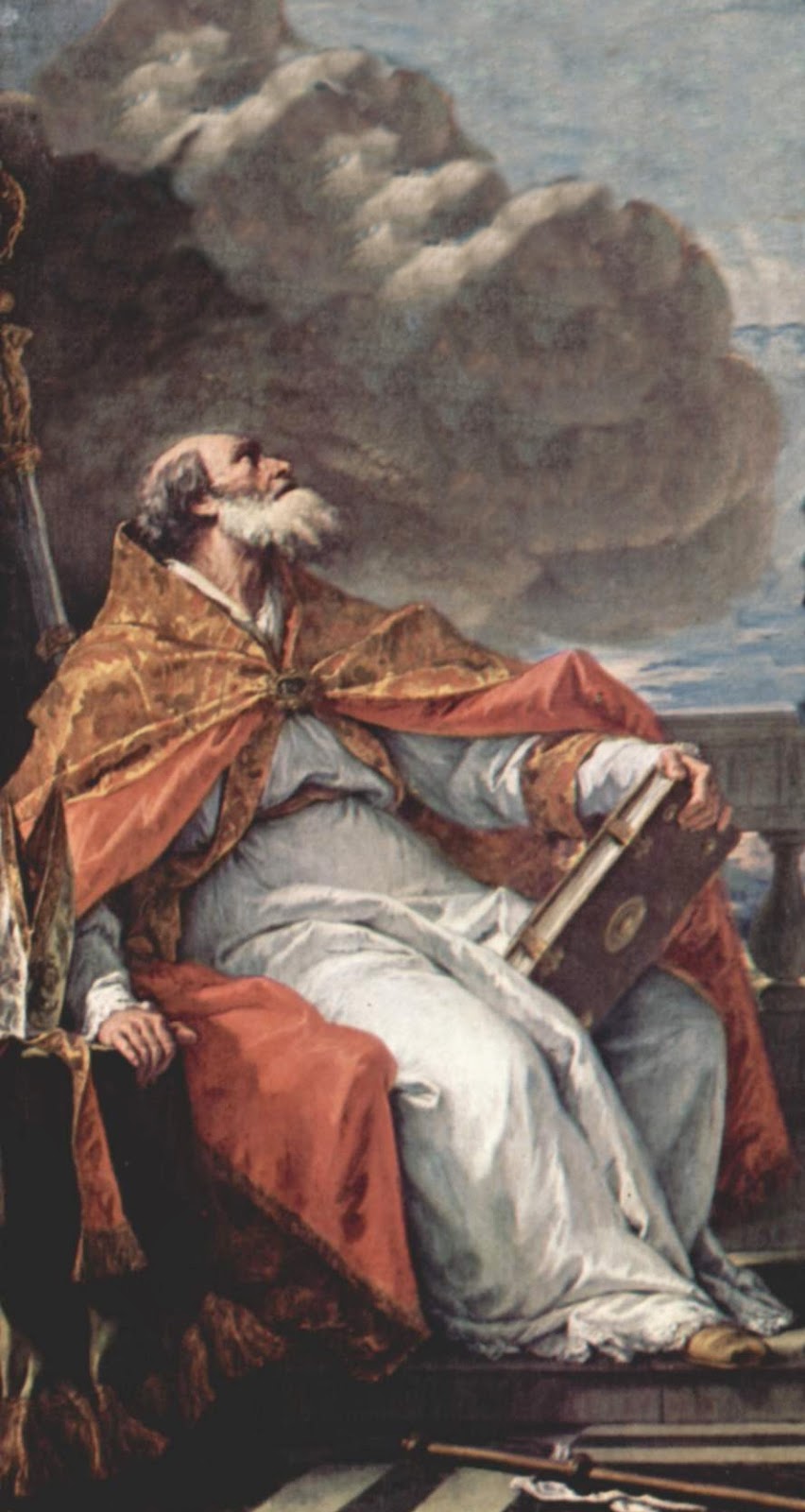
Painting: "The Transfiguration" 
by William Fergusson Hole RSA (1846 – 1917)

Friday, August 4, 2023

Dedication of the Basilica of St. Mary Major


The Basilica of St. Mary Major is important to Christendom for three reasons.

- It stands as a venerable monument to the Council of Ephesus (431), at which the dogma of Mary's divine Motherhood was solemnly defined; the definition of the Council occasioned a most notable increase in the veneration paid to Mary.

- The basilica is Rome's "church of the crib," a kind of Bethlehem within the Eternal City; it also is a celebrated station church, serving, for instance, as the center for Rome's liturgy for the first Mass on Christmas. In some measure every picture of Mary with the divine Child is traceable to this church.

- St. Mary Major is Christendom's first Marian shrine for pilgrims. It set the precedent for the countless shrines where pilgrims gather to honor our Blessed Mother throughout the world. Here was introduced an authentic expression of popular piety that has been the source of untold blessings and graces for Christianity in the past as in the present.

The beginnings of St. Mary Major date to the Constantinian period. Originally it was called the Sicinini Basilica; it was the palace of a patrician family by that name before its transformation into a church by Pope Liberius. The story of its origin is legendary, dating from the Middle Ages. The Breviary gives this version: "Liberius was on the chair of Peter (352-366) when the Roman patrician John and his wife, who was of like nobility, vowed to bequeath their estate to the most holy Virgin and Mother of God, for they had no children to whom their property could go. The couple gave themselves to assiduous prayer, beseeching Mary to make known to them in some way what pious work they should subsidize in her honor.

Mary answered their petition and confirmed her reply by means of the following miracle. On the fifth of August — a time when it is unbearably hot in the city of Rome — a portion of the Esquiline would be covered with snow during the night. During that same night the Mother of God directed John and his wife in separate dreams to build a church to be dedicated to the Virgin Mary on the site where they would see snow lying. For it was in this manner that she wanted her inheritance to be used.

John immediately reported the whole matter to Pope Liberius, and he declared that a similar dream had come to him. Accompanied by clergy and people, Liberius proceeded on the following morning in solemn procession to the snow-covered hill and there marked off the area on which the church in Mary's honor was to be constructed.

Under Pope Sixtus III (432-440) the basilica was rebuilt, and upon the occasion of the definition of Mary's divine Motherhood by the Council of Ephesus, consecrated to her honor (432). He decorated the apse and walls with mosaics from the lives of Christ and His blessed Mother, which even to this day beautify the church and belong to the oldest we possess. As early as the end of the fourth century a replica of the Bethlehem nativity grotto had been added; on this account the edifice became known as "St. Mary of the Crib." To the Christian at Rome this church is Bethlehem. Other names for the basilica are: Liberian Basilica, because it dates to the time of Pope Liberius; St. Mary Major (being the largest church in Mary's honor in Rome); Our Lady of the Snow, because of the miracle that supposedly occasioned its erection.

We could point out how the divine Motherhood mystery dominates all Marian liturgy; for the Theotokos doctrine has kept Mariology Christo-centric in the Church's worship. Although recent popular devotion to Mary has become to a certain extent soft and sentimental and has, one may say, erected its own sanctuary around Mary as the center, devotion to our Blessed Mother in the liturgy has always remained oriented to Christ. In the liturgy the divine Motherhood has always been the bridge from Mary to Jesus. One need only examine Matins in honor of Mary or the Masses from her Common to be reassured. Everywhere Christ takes the central position, and Mary is the Christbearer.

(Taken from The Church's Year of Grace by Pius Parsch)


Pope Liberius tracing the outline of the basilica in the August snowfall.

The High Altar.

Reliquary containing the major relic of the Manger.

Thursday, August 3, 2023

The Inestimable Gift of the Priesthood


In the year 2009, the Holy Father Pope Benedict XVI proclaimed a “Year for Priests” which marked the 150th anniversary of the birth of St. John Vianney, the Patron Saint for priests. In his letter of proclamation, the Holy Father included these words:

Saint John Mary Vianney taught his parishioners primarily by the witness of his life. It was from his example that they learned to pray, halting frequently before the tabernacle for a visit to Jesus in the Blessed Sacrament. “One need not say much to pray well” – the Curé explained to them – “We know that Jesus is there in the tabernacle: let us open our hearts to him, let us rejoice in his sacred presence. That is the best prayer." And he would urge them: “Come to communion, my brothers and sisters, come to Jesus. Come to live from him in order to live with him… “Of course you are not worthy of him, but you need him!”. This way of educating the faithful to the Eucharistic presence and to communion proved most effective when they saw him celebrate the Holy Sacrifice of the Mass. Those present said that “it was not possible to find a finer example of worship… He gazed upon the Host with immense love”. “All good works, taken together, do not equal the sacrifice of the Mass” – he would say – “since they are human works, while the Holy Mass is the work of God”. He was convinced that the fervour of a priest’s life depended entirely upon the Mass: “The reason why a priest is lax is that he does not pay attention to the Mass! My God, how we ought to pity a priest who celebrates as if he were engaged in something routine!”. He was accustomed, when celebrating, also to offer his own life in sacrifice: “What a good thing it is for a priest each morning to offer himself to God in sacrifice!"


In my forty years as a Catholic priest, the offering of the Mass each day has formed the heart of my spiritual life. Rare has been the day that I have not stood at the altar, offering the Holy Sacrifice, and those few days I have not done so, it has been because of illness or something unavoidable.

Even though now in retirement I am alone in my private chapel on most days, nonetheless I have the immense privilege of joining with the Faithful throughout the world in lifting up to the Father the perfect Sacrifice of the Body and Blood of Jesus Christ. It is a special joy when I am joined by family for Mass on Sundays and Holy Days, but whether the Chapel is full or if I am by myself, it is the same Sacrifice with the same dignity as a Mass offered on the high altar in St. Peter’s Basilica.

I have gone back frequently to the Holy Father’s letter inaugurating the Year of the Priest, drawing inspiration and guidance from his words, and giving thanks for the inestimable gift of being a priest in Christ’s One, Holy, Catholic, and Apostolic Church.

---------------------

You can read the whole letter at this link:
https://www.vatican.va/content/benedict-xvi/en/letters/2009/documents/hf_ben-xvi_let_20090616_anno-sacerdotale.html

St. John Vianney


St. John Vianney, also known as the Holy Curé de Ars, was born May 8, 1786 in Dardilly, near Lyon, France to a family of farmers. He was an unremarkable student and his bishop was reluctant to ordain him.  He did so in 1815 only because there was a shortage of priests.  He was then sent to the remote French community of Ars in 1818 to be a parish priest.

Upon his arrival, the priest immediately began praying and working for the conversion of his parishioners. Although he saw himself as unworthy of his mission as pastor, he allowed himself to be consumed by the love of God as he served the people.

St. John Vianney slowly helped to revive the community’s faith through both his prayers and the witness of his life. He gave powerful homilies on the mercy and love of God, and it is said that even staunch sinners were converted upon hearing him. In addition, he restored his church, formed an orphanage, and cared for the poor.

His reputation as a confessor grew rapidly, and pilgrims traveled from all over France to come to him in the Sacrament of Reconciliation. Firmly committed to the conversion of the people, he would spend up to 16 hours a day in the confessional.

Plagued by many trials and besieged by the devil, St. John Vianney remained firm in his faith, and lived a life of devotion to God. Dedicated to the Blessed Sacrament, he spent much time in prayer. He lived on little food and sleep, while working without rest in unfailing humility, gentleness, patience and cheerfulness, until he was well into his 70s.

St. John Vianney died on August 4, 1859. More than a thousand people attended his funeral, including the bishop and priests of the diocese, who already viewed his life as a model of priestly holiness.

The Holy Curé of Ars was canonized by Pope Pius XI in 1925. He is the patron saint of priests. Over 450,000 pilgrims travel to Ars every year in remembrance of his holy life.

Almighty and merciful God, who didst wonderfully endue Saint John Vianney with pastoral zeal and a continual desire for prayer and penance: grant, we beseech thee; that by his example and intercession, we may win the souls of our brethren for Christ, and with them attain glory everlasting; through the same Jesus Christ thy Son our Lord, who liveth and reigneth with thee, in the unity of the Holy Spirit, ever one God, world without end. Amen.

Tuesday, August 1, 2023

St. Peter Julian Eymard


Born in La Mure d'Isere in southeastern France, Peter Julian's journey of faith drew him from being a priest in the Diocese of Grenoble (1834) to joining the Marists (1839) to founding the Congregation of the Blessed Sacrament (1856). In addition to those changes, Peter Julian coped with poverty, his father's initial opposition to Peter's vocation, serious illness, a Jansenistic striving for inner perfection and the difficulties of getting diocesan and later papal approval for his new religious community.

His years as a Marist, including service as a provincial leader, saw the deepening of his Eucharistic devotion, especially through his preaching of Forty Hours in many parishes.

The Congregation of the Blessed Sacrament began working with children in Paris to prepare them to receive their first Holy Communion. It also reached out to non-practicing Catholics, inviting them to repent and begin receiving Holy Communion again. He was a tireless proponent of frequent Holy Communion, an idea given more authoritative backing by Pope Pius X in 1905.

Inspired at first by the idea of reparation for indifference to the Eucharist, St. Peter Julian was eventually attracted to a more positive spirituality of Christ-centered love. Members of the men's community, which Peter founded, alternated between an active apostolic life and contemplating Jesus in the Eucharist. He and Marguerite Guillot founded the women's Congregation of the Servants of the Blessed Sacrament.

Peter Julian Eymard was beatified in 1925 and canonized in 1962, one day after the first session of the Second Vatican Council ended.

O God, who didst adorn St. Peter Julian Eymard with a wondrous love for the sacred mysteries of the Body and Blood of thy divine Son; grant that we may be worthy to receive the same devotion he drew from this holy banquet; through the same Jesus Christ thy Son our Lord, who liveth and reigneth with thee, in the unity of the Holy Ghost ever, one God, world without end. Amen.

St. Eusebius of Vercelli


Eusebius was the founder of the canons regular, priests living under a religious rule and dedicated to pastoral work. The canons regular was the immediate result of the rise of monasticism in the East, and St. Eusebius of Vercelli saw the possibilities of this new movement for the clergy. His example was imitated all over the West and brought about a renewal of clerical life. 

He was born in Sardinia and as a child was taken to Rome, where he became a member of the Roman clergy under Pope Julius. Consecrated for the see of Vercelli in 344, he gathered his clergy into a community life, founding also the dioceses of Turin and Embrun. In 355, he attended the Council of Milan as legate of Pope Liberius, which defended St. Athanasius against those Western bishops intimidated by the emperor. When Eusebius was ordered along with other bishops to condemn Athanasius, he refused, insisting instead that they all sign the Nicene Creed. When threatened by the emperor, Eusebius stood his ground and told the emperor he had no right interfering in Church matters.

In anger, the emperor sent Eusebius into exile in Palestine, where he was severely mistreated by the Arians. He was moved around from place to place and after his release by the Emperor Julian he consulted with Athanasius in Alexandria on the Arian crisis. Returning to Italy, he joined with St. Hilary of Poitiers in opposing the Arian bishop of Milan and returned to Vercelli amid the rejoicing of his people.

Eusebius is considered by many to be the author of the Athanasian Creed, and a copy of the Gospels written in his own hand is preserved in the cathedral at Vercelli. He died on August 1, 371, his courage in suffering for the faith inspiring other bishops to oppose the Arian heresy.

Lead us, O Lord God, to imitate the constancy of Saint Eusebius in affirming the divinity of thy Son: that, by preserving the faith he taught as thy Bishop, we may merit a share in the very life of the same Jesus Christ thy Son our Lord; who liveth and reigneth with thee, in the unity of the Holy Spirit, ever one God, world without end. Amen.

Monday, July 31, 2023

The Portiuncula Indulgence


On a night in July 1216, St. Francis was at prayer in the little church of Portiuncula, devoured by love for God and a thirst to save souls. He prayed for the forgiveness of sins of mankind. Suddenly a brilliant light shone all around. In great splendor Jesus and Mary appeared in the midst of a dazzling cloud surrounded by a multitude of radiant angels. ...Then Jesus said to him: "Francis you are very zealous for the good souls. Ask me what you want for their salvation." St. Francis was rapt in ecstasy before Our Lord. When he regained his courage, he said, "Lord, I, a miserable sinner, beg you to concede an indulgence to all those who enter this church, who are truly contrite and have confessed their sins. And I beg Blessed Mary, your mother, intercessor of man, that she intercede on behalf of this grace."

The Merciful Virgin at once began to beseech her Son on behalf of Francis. Jesus answered: "It is a very great thing you ask me; but you are worthy of even greater things, Friar Francis, and greater things you will have. So I accept your request, but I want you to go to my Vicar, to whom I have given the power to bind and loose in heaven and on earth, to ask him on my behalf for this indulgence."

The Pope granted this petition, and this indulgence has been extended to all parish churches throughout the world for one day each year. The date has been set from noon on August 1 until midnight August 2, the feast of Our Lady of the Angels. It is said that St. Francis was given this day by Our Lord because of the feast of the Chains of St. Peter, celebrated on August 1, commemorating Peter's being released from prison, his chains removed. This is an extraordinary demonstration of God's mercy in removing the chains of sin from those who devoutly and faithfully seek to gain the indulgence by completing its requirements.

The conditions to obtain the Plenary Indulgence of the Forgiveness of Assisi (for oneself or for a departed soul) are as follows:

- Sacramental Confession (during eight days before or after).
- Participation in the Mass
- Recitation of the Apostle's Creed, Our Father, and a prayer for the pope's intentions.

St. Alphonsus Liguori, Bishop and Doctor


Alphonsus Liguori, born in 1696, was the son of an ancient Neapolitan family. His father was an officer in the Royal Navy. At the age of sixteen, Alphonsus received his doctorate in both canon and civil law and for nearly ten years practiced law. When he found that one of the legal cases he was defending was not based on justice but on political intrigue, he gave up the practice of law and dedicated his life to God.

Ordained to the priesthood in 1726, St. Alphonsus Liguori joined a group of secular priests dedicated to missionary activities. He involved himself in many kinds of pastoral activities, giving missions and organizing workers, and had a part in the founding of an order of contemplative nuns.

In 1732, he founded the Redemptorists, a congregation of priests and brothers, to work especially among the country people of Italy who often lacked the opportunity for missions, religious instruction, and spiritual retreats. His first companions deserted him, but Alphonsus stood firm, and soon vocations multiplied and the congregation grew.

The Redemptorists were approved by Pope Benedict XIV in 1749, and St. Alphonsus was elected superior general. In 1762, he was appointed bishop of Sant' Agata near Naples, and as bishop he corrected abuses, restored churches, reformed seminaries, and promoted missions throughout his diocese. During the famine of 1763-64, his charity and generosity were boundless, and he also carried on a huge campaign of religious writing.

In 1768, he was stricken with a painful illness and resigned his bishopric. During the last years of his life, problems in his congregation caused him much sorrow and when he died on August 1, 1787, at Pagani, near Salerno, the Congregation of the Redemptorists was in a state of division. 

St. Alphonsus was beatified in 1816, canonized in 1839, and declared a Doctor of the Church in 1871.

O God, who didst inflame blessed Alphonsus, thy Confessor and Bishop, with zeal for souls, and didst through him enrich thy Church with a new offspring: we beseech thee; that being taught by his wholesome precepts and strengthened by his example, we may be enabled to attain in gladness unto thee; through Jesus Christ thy Son our Lord, who liveth and reigneth with thee, in the unity of the Holy Spirit, ever one God, world without end. Amen.

Sunday, July 30, 2023

St. Ignatius of Loyola

The Shrine of St. Ignatius
at the Church of the Gesu in Rome.

St. Ignatius of Loyola was born at Loyola in the mountains of northern Spain in 1491. A member of the minor nobility, Ignatius spent his youth and early adulthood as a courtier and soldier. He occasionally vowed to dedicate himself more fully to God, but never quite followed through. It was only after he read the lives of the saints while convalescing from a leg wound incurred during a battle that he finally began his spiritual pilgrimage with real intent at the age of 30.

Soon after this, St. Ignatius began to experience ecstatic visions, but within a year suffered a period of intense spiritual dryness (what St. John of the Cross termed the “dark night of the soul”), which nearly drove him to despair. He persevered, however, and out of this was born Spiritual Exercises, one the most important Catholic spiritual works of all time. Ignatius was a true mystic. He centered his spiritual life on the essential foundations of the Faith - the Trinity, Christ, the Eucharist. His spirituality is expressed in the Jesuit motto, Ad majorem Dei gloriam - “for the greater glory of God.” 

In spite of his noble origins, St. Ignatius lived an astonishingly humble lifestyle, which others often resented. Yet he attracted several followers (including St. Francis Xavier), and in 1540 received approval from Pope Paul III for his new order, The Society of Jesus, or the Jesuits. In a very short time, this order would go on to become one of the best known of all Catholic religious orders, taking the Gospel to the four corners of the world.

O God, who for the greater glory of thy Name, didst endue thy Church militant with an increase of strength through the life and labours of blessed Ignatius: grant us, by his help and example, so to wage our earthly warfare; that with him we may be found worthy of a heavenly crown; through Jesus Christ thy Son our Lord, who liveth and reigneth with thee, in the unity of the Holy Spirit, ever one God, world without end. Amen.

Church of the Gesu, Rome.

Saturday, July 29, 2023

The Most Important Thing


Jesus said to the crowds, “The kingdom of heaven is like treasure hidden in a field, which a man found and covered up; then in his joy he goes and sells all that he has and buys that field. Again, the kingdom of heaven is like a merchant in search of fine pearls, who, on finding one pearl of great value, went and sold all that he had and bought it.”

- St. Matthew 13:44-46

Frequently Christ would start a statement by saying, “The Kingdom of heaven is like…” and we hear Him saying exactly that in this brief portion of St. Matthew’s Gospel: “The Kingdom of heaven is like a treasure hidden in a field…” “The Kingdom of heaven is like a merchant in search of fine pearls…”

The Kingdom is a constant in the teaching of our Lord.  From His words we know it is the doing of God’s Will. It is the triumph of God’s divine Will in all things. It is that state of being in which God truly reigns.

As we hear Christ’s words, it is evident that God’s Kingdom is not like any earthly kingdom. Rather, it is mystical. It is spiritual. And it is far more important than any of the kingdoms or governments of this world.

Our Lord’s words show us that God’s Kingdom, rather than being something optional for us, is really something essential to our very existence as children of God. It is the thing which is to be desired and sought above anything else, and Christ gives us a couple of brief examples to lay out for us the priority of the Kingdom of heaven; namely, the man who finds the treasure in the field, and the merchant who discovers a rare pearl.

They each sold all they had so they could purchase what they had found. Both examples contain the same feeling of happiness at the discovery, and the need to take immediate action to claim what was found, and the preference for one thing above everything else. The man who found the treasure and the merchant are both surprised by their discoveries, and everything else seems unimportant in comparison. So they liquidate what they have accumulated up to that point, sacrificing every other possession, and they use every means they can to make this exclusive investment. Their actions mean that there is no turning back later. If the venture should fail, they would have nothing. The risk they take is total.

That is what it is like to seek the Kingdom, Jesus tells us. And when we find it, it is all we could ever want. In comparison to God’s kingdom, everything else loses its value. So one of the tests for us, in the light of Christ’s words, is this: if we are holding on to anything else as being more important than living in God’s presence, and in the desire to please God and to obey Him in everything, then we are not really seeking the Kingdom of heaven.

Finding God’s kingdom means sacrifice, because we cannot possess anything else if we want to possess the Kingdom of God. It is a kingdom which is all-embracing and completely absorbing. Possession of the Kingdom, and service to God in His kingdom, allows for no turning back, no seeing other things as being more important than our relationship with God.

And this also is true: to choose God’s kingdom is to find real contentment, real happiness. We might think that if finding the kingdom of heaven is that demanding, making us exclude everything else, it would be something difficult. But once we are on the path to God’s kingdom, it is something we want more than anything else.

______________________________

Painting: “The Pearl of Great Price”
by Domenico Fetti (1588-1623)

Friday, July 28, 2023

Ss. Martha, Mary, and Lazarus


In a decree issued in 2021 by the Congregation for Divine Worship and the Sacraments, the liturgical calendar was changed to reflect the combining of veneration of the three saints of Bethany – Martha, Mary, and Lazarus – on the 29th of July.

In part, the decree states, "In the household of Bethany, the Lord Jesus experienced the family spirit and friendship of Martha, Mary and Lazarus, and for this reason the Gospel of John states that he loved them. Martha generously offered him hospitality, Mary listened attentively to his words and Lazarus promptly emerged from the tomb at the command of the one who humiliated death."

It is apparent from the Gospel accounts that Martha, Mary, and their brother Lazarus were close friends of Jesus. He visited their home in Bethany frequently as a welcomed guest. The sisters felt free to call on Jesus at their brother’s death, even though His return to Judea at that time was very dangerous.

Martha’s great glory is her simple and strong statement of faith in Jesus after her brother’s death, when Jesus told her, “I am the resurrection and the life; he who believes in me, though he die, yet shall he live, and whoever lives and believes in me shall never die. Do you believe this?” Martha replied to Him, “Yes, Lord; I believe that you are the Christ, the Son of God, he who is coming into the world.” (John 11:25-27)

We know St. Martha to be an active person, most famously when she was preparing the meal for Jesus and wanted to know why her sister Mary wasn’t helping her. The Lord recognized that Martha was “anxious about many things,” after which He made the observation that Mary, who had spent the preparation time at His feet listening to His words “has chosen the better part.” In another place, St. John’s Gospel describes Mary’s anointing of Jesus’ feet at Bethany, which was an act He highly praised.

Immediately after we are told that the chief priests plotted to kill Lazarus “because many of the Jews were turning away and believing in Jesus because of him.” In fact, it was in the sight of many of these Jewish leaders that Jesus raised His friend Lazarus from the dead. They had witnessed Jesus weeping over the death of Lazarus, and they had said, “See how much he loved him.”

There are many legends about Lazarus after the death and resurrection of Jesus, including an account of what he saw in the next world before he was called back to life. It was held by some that he followed Peter into Syria, but there is also an account that he and his sisters were put into a leaking boat at Jaffa, but they were able to safely land in Cyprus, where he died peacefully after serving as bishop for 30 years.

O ALMIGHTY God, who willest to be glorified in thy Saints, and didst raise up thy servants Martha, Mary, and Lazarus to shine as a light in the world: shine, we pray thee, in our hearts; that aided by their prayers we also in our generation may show forth thy praises, who hast called us out of darkness into thy marvellous light; through Jesus Christ thy Son our Lord, who liveth and reigneth with thee, in the unity of the Holy Spirit, ever one God, world without end. Amen.
__________________________________________

Pictured: "Raising of Lazarus" by Giotto (1267-1337)

Tuesday, July 25, 2023

St. Joachim and St. Anne


According to tradition, St. Joachim and St. Anne have come to us as being the names of the parents of Mary, the Mother of God. They are not named in the canonical Scriptures, but this tradition dates back to the early years of the Church, as does the story which tells us that after many years of not having a child, an angel appeared to them and told them that God would be granting them this blessing.  

They had prayed for a child, and part of their prayer was the promise that they would dedicate their child to the service of God. Little did they know at that time what great service would be given by their infant daughter.

When Mary reached the age of three, her parents fulfilled their vow. Together with their family and friends, they took her to the Temple. The High Priest and other Temple priests greeted the procession, and tradition says that the child was brought before the fifteen high steps which led to the sanctuary. It is said that the child Mary made her way to the stairs and, strengthened by the Holy Spirit, ascended all fifteen steps, coming to the Holy of Holies where only the High Priest could enter. Tradition then says that the High Priest, acting outside every rule he knew, led the Holy Virgin into the Holy of Holies, astonishing everyone present in the Temple. So it was that she, whose own womb would become the Holy of Holies, came into the presence of the God Whom she would bear.

St. Joachim and St. Anne returned to their home, but their daughter, the Handmaid of the Lord, remained in the Temple until her espousal, where she was prepared by God.  As the grandparents of our Saviour Jesus Christ, they serve as examples and intercessors for all parents and grandparents.

O God, who didst choose blessed Joachim and holy Anne that of them might be born the Mother of thine Only Begotten Son: grant unto us, at their intercession, a place in the fellowship of thine elect, wherein for ever to praise thee for thy lovingkindness; through the same Jesus Christ thy Son our Lord, who liveth and reigneth with thee, in the unity of the Holy Spirit, ever one God, world without end. Amen.

St. Christopher, Martyr


I would be remiss if I didn't remember St. Christopher today. He is my primary patron, and he is linked with St. George, whose name I was also given when I was baptized.

It is generally agreed that St. Christopher did live in the late third and early fourth century. He was taken prisoner in a war with the Romans in North Africa, in present day Libya. He was forced to travel a great distance back to Rome and was assigned as a Roman army officer during the reign of Emperor Diocletian.

A terrible persecution of Christians took place at the command of this emperor. It was one of Diocletian's own guards who refused to participate in the persecution and proclaimed himself a Christian. This guard was St. George. The emperor ordered that St. George be tortured and killed. St. Christopher, who was a soldier there at the time, watched the torture and killing of St. George, and shortly after declared himself also to be a Christian, an admission which caused him to be put to death.

It is thought that his name originally was Reprobus, but was changed to Christopher, meaning "Christ-bearer," because of the story which tells of a child approaching St. Christopher by a river, who asked to be helped across. St. Christopher obliged. However, as he entered midstream, the river rose and the child's weight grew and became extremely heavy. It was only by great exertion that St. Christopher safely delivered the child to the other side. When St. Christopher asked the child why He was so heavy, the child explained that He was the Christ and when St. Christopher carried Him, he also carried the weight of the whole world on his shoulders. The child then vanished.

Although St. Christopher is no longer included in the Church's general liturgical calendar, he is commemorated on July 25th in those places dedicated to him, as well as by those who bear his name. He continues to be invoked as a patron for travellers, and is counted as one of the Fourteen Holy Helpers, a group of saints known for their particularly powerful intercession.

This Collect is from the Sarum Missal:

Concede, quaesumus, omnipotens et misericors Deus, ut qui beati Christophori martyris tui memoriam agimus, ejus piis meritis et intercessionibus a morte perpetua, subitanea peste, fame, timore, paupertate, et ab omnibus insidiis inimicorum liberemur in terris; per te Jesu Christe, salvator mundi, rex gloriae, quem idem Christophorus meruit in suis humeris portare. Qui vivis et regnas cum Deo Patre, in unitate Spiritus sancti Deus: per omnia secula seculorum. Amen.

[Grant, we ask, almighty and merciful God, that we who keep the memory of Thy blessed martyr Christopher, by his pious merits and intercession may be delivered on earth from perpetual death, sudden plague, famine, fear, poverty, and from all the snares of our enemies; through Thee, Jesus Christ, Savior of the world, and King of glory, whom the same Christopher merited to bear upon his shoulders. Who livest with the Father, in the unity of the Holy Spirit, one God, for ever and ever. Amen.]
__________________________________________

Painting: "St. Christopher Carrying the Infant Jesus" 
by Edmond Lechevallier-Chevignard (1825-1902)

Monday, July 24, 2023

St. James the Greater, Apostle


St. James the Greater (meaning the Elder) and his brother John were partners in the fishing business with two other brothers, Peter and Andrew.  They all lived in Bethsaida, a village on the north shore of the Sea of Galilee. His mother was a sister of the Blessed Virgin Mary, and he would have known Jesus from childhood. He is one of those that Jesus called Boanerges, "sons of thunder," the brother of St. John the Evangelist and the son of Zebedee the fisherman from Galilee.

Along with Peter and John, James was part of the inner circle of Jesus, the ones who witnessed the Transfiguration, and who were witnesses to certain of His miracles, such as the raising of the daughter of Jairus. Like his brother, James was active in the work of evangelization after the death of Jesus, and there is some evidence that he went to Spain after our Lord's resurrection.  In fact, the great Cathedral of Santiago de Compostela witnesses to that probability.

St. James' prominence and his presence in Jerusalem was well known.  Scarcely a dozen years after the Resurrection he was arrested and executed by King Herod Agrippa. This was followed by the arrest of Peter also, so his death must have been part of a purge of Christian leaders by Agrippa, who saw the new Christian movement as a threat.

Jesus had foretold this kind of fate when He prophesied that James and his brother John would "drink of the same chalice" of suffering as Himself. Along with their mother's request, the two brothers had asked to be seated at the right of Jesus and at His left in His kingdom, and Jesus told them that they would be with Him, but it turned out to be in a far different way than they expected.

Grant, O merciful God, that as thine holy Apostle Saint James, leaving his father and all that he had, without delay was obedient unto the calling of thy Son Jesus Christ, and followed him: so we, forsaking all worldly and carnal affections, may be evermore ready to follow thy holy commandments; through Jesus Christ thy Son our Lord, who liveth and reigneth with thee, in the unity of the Holy Spirit, ever one God, world without end. Amen.

Sunday, July 23, 2023

St. Sharbel Makhluf


St. Sharbel Makhluf is a Maronite saint, a member of the ancient Eastern Catholic Church of Antioch.  It was in Antioch that Christ's followers were first called Christians, and St. Peter ministered there before going to Rome.  The Maronites have their own liturgy and discipline, and have always been in full communion with the See of Peter.  They take their name from St. Maron, a fifth century monk and patriarch of Antioch.


Although this saint never traveled far from the Lebanese village of Beka-Kafra where he was born, his influence has spread widely.


Joseph Zaroun Makluf was raised by an uncle because his father, a mule driver, died when Joseph was only three. At the age of 23, Joseph joined the Monastery of St. Maron at Annaya, Lebanon, and took the name Sharbel in honor of a second-century martyr. He professed his final vows in 1853, and was ordained six years later.


Following the example of the fifth-century Saint Maron, Sharbel lived as a hermit from 1875, until his death. His reputation for holiness prompted people to seek him to receive a blessing and to be remembered in his prayers. He followed a strict fast and was very devoted to the Blessed Sacrament. When his superiors occasionally asked him to administer the sacraments to nearby villages, Sharbel did so gladly.


He died in the late afternoon on Christmas Eve. Christians and non-Christians soon made his tomb a place of pilgrimage and of cures. He was beatified in 1965, and canonized 12 years later.


O God, who didst call the Priest Saint Sharbel Makhluf to the solitary combat of the desert and imbued him with all manner of devotion: grant us, we pray thee; that, being made imitators of the Lord’s Passion, we may merit to be coheirs of his kingdom; through Jesus Christ thy Son our Lord, who liveth and reigneth with thee, in the unity of the Holy Spirit, ever one God, world without end. Amen.